Every dealer hears it:
“What’s the most reliable tractor you sell?”
It sounds like a product question. It’s actually a trust question.
Farmers aren’t asking you to crown a winner. They’re asking whether this decision will cost them time, money, or sleep when it matters most. Dealers who lead with a brand name risk missing the moment. Dealers who anchor the conversation in a reliability framework buyers already follow earn credibility.
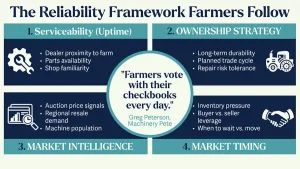
“Choosing the right machine isn’t about the flashiest specs or the biggest logo,” says Casey Seymour, VP of Machinery at Farm Journal. “It comes down to serviceability, market conditions, budget alignment, and long-term resale.”
Here’s how leading dealers are reframing reliability, and how many dealers are choosing to market it.
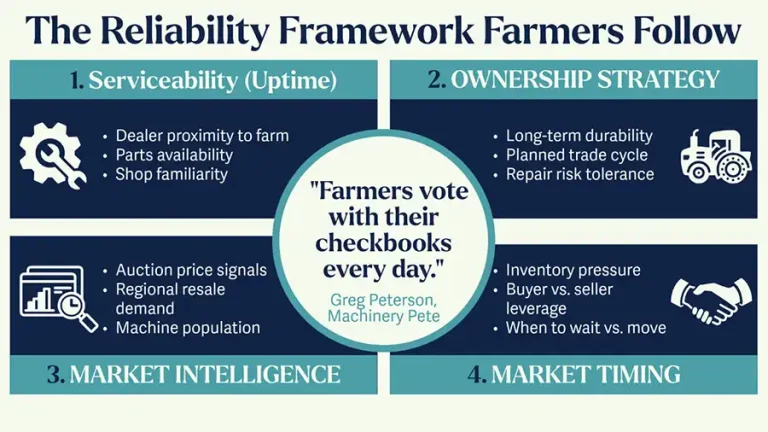
Step 1: Reframe Reliability as Uptime, Not Brand
Instead of answering the question head-on, reposition it:
“The most reliable tractor is the one we can keep running for your operation.”
Then guide the buyer with questions that matter more than paint color:
- How far are you from our service department?
- What does an hour of downtime cost you during planting or harvest?
- Do you rely on dealer service, or do you wrench in-house?
This shifts the discussion from opinion to operational reality, and positions your dealership as part of the reliability equation.
Dealer takeaway: Market your service footprint, response times, and parts availability as aggressively as horsepower and hydraulics. Reliability starts with support, not brochures.
Step 2: Clarify the Ownership Strategy Early
Reliability means different things depending on how the farmer plans to own the machine.
Ask:
- Is this a 10–15 year workhorse?
- Or a 3–5 year asset you plan to trade?
Long-term owners often value simplicity, familiarity, and deep parts availability. Short-cycle buyers should focus on depreciation curves and resale demand.
Neither approach is wrong, but each requires a different recommendation.
Dealer takeaway: Market machines as assets with a lifecycle, not just products. Show you understand how farmers manage risk over time.
Step 3: Use Auction Data to Let the Market Speak
Auction data removes emotion — and removes pressure from the dealer.
You don’t need to sell against competitors. You can say:
- “Here’s what machines like this bring after five years.”
- “In this region, this model typically retains X% of its value.”
Often, two tractors with similar specs bring very different prices at auction. That premium reflects serviceability, familiarity, and resale confidence — not marketing slogans.
Farmers trust this data because it represents real money, paid by real buyers.
As Greg Peterson, known to most farmers as Machinery Pete, puts it:
“Farmers vote with their checkbooks every day.”
Dealer takeaway: Use auction results as a neutral credibility tool in both marketing and sales conversations. Data builds trust faster than opinions.
Step 4: Be Honest About Market Timing
Reliability isn’t just about the machine — it’s about when you buy it.
If inventory is heavy, say so.
If supply is tightening, say that too.
In early 2026, some segments remain elevated compared to historic norms, while others are tightening regionally. That changes where farmers have leverage — and smart dealers help buyers navigate that reality.
Dealer takeaway: Lead with transparency, not urgency. Helping a farmer buy at the right time builds trust that outlasts any single transaction.
The Dealer Reliability Framework (What to Market)
When farmers ask about reliability, your answer shouldn’t be a logo.
It should be a conversation that connects:
- Service and uptime support
- Ownership timeline
- Market conditions
- Real-world resale performance
That’s the intelligence delivered every week by Farm Journal, Machinery Pete, and Moving Iron — auction data, inventory trends, and buyer behavior that explain why machines hold value, not just which ones do.
Dealers who market this way don’t just sell equipment. They help farmers make confident decisions.
In today’s ag machinery market, trust is the most reliable asset you have.